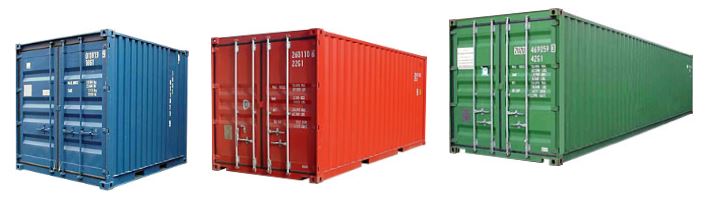
What is a freight forwarder

International Freight Forwarders

There are a lot of confusion when it comes to the various companies offering logistics services. from International freight forwarders to  3PL, 4PL and 7PL companies in addition to the many other types of companies.

International Freight Forwarders


Below is a simple definition of a freight forwarder

A Firm specializing in arranging storage and shipping of merchandise on behalf of its shippers. It usually provides a full range of services including: tracking inland transportation, preparation of shipping and export documents, warehousing, booking cargo space, negotiating freight charges, freight consolidation, cargo insurance, and filing of insurance claims. Freight forwarders usually ship under their own bills of lading or air waybills (called house bill of lading or house air waybill) and their agents or associates at the destination (overseas freight forwarders) provide document delivery, deconsolidation, and freight collection services. Also called forwarder.

Many traditional freight forwarding companies are offering other services such as: warehousing, distribution, pick and pack services and transportation management.

This has given rise to what we call 3PL companies.

While the idea of moving cargo from A to B sounds simple, like importing, there are complex regulations that govern the movement of freight worldwide. Every country has its own regulations, and different products have different requirements, and keeping track of them all can be daunting for small business owners.

That’s where working with the right freight forwarding company is essential. a freight forwarder should be able to offer you personalized service and  focus on compliance, you can rest easy knowing that your cargo is in good hands and that you won’t be faced with any surprise charges or delays.

International shipping is by now means easy. Shipping a container involves many activities that most people are not aware of. With more and more regulations affecting imports, international freight companies have to stay on top of all the changes in the market place.

Resources:
7pl Logistics


How to Calculate Dimensional Weight

What is dimensional weight?

Dimensional weight reflects package density, which is the amount of space a package occupies in relation to its actual weight.

Billable weight is the weight used to calculate your rate. For domestic and international services, the billable weight will either be the dimensional weight or the actual weight of your package (whichever number is greater).

Dimensional Weight

How is dim weight calculated?

Dimensional weight is calculated based on the length, height, and width of the package. The dimensional weight becomes the billable weight when the dimensional weight of your package exceeds its actual weight.

Follow these easy steps to calculate dimensional weight:

  1. Calculate the cubic size of your package in inches. Multiply the length by width by height of your package. Round each measurement to the nearest whole inch. The resulting total is the cubic size of your package.
  2. Determine actual weight. Use any standard scale to determine the actual weight of your package. Increase any fraction to the next whole pound.
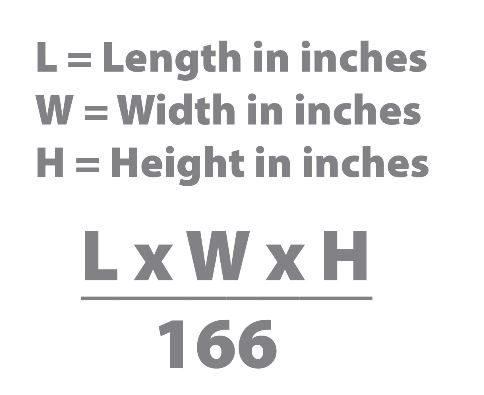
  3. Determine dimensional weight. Divide the cubic size of your package in inches by 166 (for shipments within the U.S. and shipments between the U.S. and Puerto Rico) or 139 ( for international shipments).
  4. Determine billable weight. Compare the package’s actual weight to its dimensional weight. The larger of the two weights is the billable weight and should be used to calculate the rate.
  5. For multiple-package shipments, total the billable weight of all packages in the shipment.


This method is used to calculate Air and Ocean freight charges billed by shipping companies. When a package is delivered to a shipping company, it is weighed and the volume is determined. The charge of the shipment is based on whatever is higher.

Sample Calculation of chargeable weight

Ship Method / Destination: Ground / Domestic
Actual Weight: 21 pounds
Length: 30 inches
Width: 12 inches
Height: 12 inches
Cubic Size Calculation: 30 x 12 x 12 = 4,320 cubic inches
Dimensional Weight Calculation: 4,320/166 = 26 pounds

In this first example, because it is a domestic shipment, we multiply the total cubic size in inches by 166. In doing so, we find out that the dimensional weight is 26 pounds, which is greater than the actual weight.

However, because the package is being shipped via ground service and is less than 5,184 cubic inches, the dimensional weight is not applied. So in this case, the actual weight of 21 lbs. becomes the billable weight.

Ship Method / Destination: Air / International
Actual Weight: 18 pounds
Length: 24 inches
Width: 12 inches
Height: 12 inches
Cubic Size Calculation: 24 x 12 x 12 = 3,456 cubic inches
Dimensional Weight Calculation: 3,456/139 = 25 pounds


Types of shipping containers

Know your shipping container

Ocean containers of various types: the standard 20-foot container, standard 40 ft container, 40 ft container of high capacity, Open Top and Flat Rack. External and internal dimensions, container door dimensions, capacity and max cargo weight.

Types of Shipping Containers


Types of shipping containers and dimensions

Size Door Openings*
mm
feet/inches
Internal Dimensions*
mm
feet/inches
Volume*
m3
cubic feet
Feet/inches Width Height Length Width Height Capacity
20 standard
20′ X 8′ X 8’6″
2.340
7′ 8″
2.274
7′ 6″
5.896
19′ 4″
2.350
7′ 8″
2.393
7′ 10″
33
1,170
40 standard
40′ X 8′ X 8’6″
2.340
7′ 8″
2.274
7′ 6″
12.032
39′ 6″
2.350
7′ 8″
2.392
7′ 10″
67
2,390
40 High
40′ X 8′ X 9’6″
2.640
7′ 8″
2.577
8′ 6″
12.032
39′ 6″
2.350
7′ 8″
2.697
8′ 10″
76
2,700
45 High
45′ X 8′ X 9’6″
2.340
7′ 8″
2.584
8′ 5″
13.556
44′ 6″
2.347
7′ 8″
2.696
8′ 10″
86
3,055

Move your fulfillment closer to your customers.

Tell us about your products, order volume, and current pain points. We'll design a micro fulfillment solution that fits your operations and budget.

Request a Micro Fulfillment Quote