
How 5G Wireless will Change the Logistics Industry

New 5G Wireless technology promises to make everything connected. The Next Generation 5G wireless  will supercharge cell phones, but its real potential lies it potential to power everything electronic other than smart phones.

The New technology with greatly influence a technology hungry field like Logistics.

Right now, GPS is used to track trucking companies who carry shipments that are loaded on trucks, wouldn’t be nice to be able to track your pallet live knowing exactly where it is? 5G wireless promises to be faster with less latency.

Warehouses use RF ( Radio frequency ) to transmit data through the warehouse to track an package from the time the order is placed until the package leave the warehouse, providing weight, dims to the WMS system?  How would you like to have that data available live from the time the order is entered until the end user signs for it under one platform. Imagine that application being applied to international shipments too.

What we are looking at is your 3PL company being able to offer all the information about your package from the time you end an order to ship until it is delivered.

5G wireless promises to be the holy grail of logistics.

Factories have relied in wires for along time since wireless technology is spotty and slow making it hard for machines to perform their functions. Now factories will benefit from the speed of 5G technology so will the shipping companies.

We are looking at being able to track the container while at see without having to rely on the internet portal of the shipping company  Your will be able to see the location of your container live on a map even if it being trucked from one location to another.

But don’t hold your breath, you will not see the full power of this technology until probably 5 years from now as cellular providers complete building the network.

Ms. Krys Siles, a spokesperson for International 3PL, a Miami Based 3Pl Company, stated that implementing 5G wireless is a priority for international 3Pl and it will be applied to both the freight forwarding division  and Contract Logistics division.

5G wireless costs will be passed on to the consumers, all 5G Wireless devices will cost more. Right now it is a race with time for German and Chinese Businesses trying to upgrade to 5G.

If you are planning on buying a 5G capable phone, you should wait. it will be 2 years at least before there is in enough coverage. 5G is faster but has less capability of penetrating walls.


resources:
3Pl conpanies:

International Shipping

Freight Forwarders

The future of freight forwarding

When do you think about freight forwarding? I hardly believe you think of it when you pick up a toy or a toaster oven from your local store. There is a 90% chance that a freight forwarder was involved somewhere to bring the product to your fingertips.

A freight forward is an important part of the supply chain. Now let’s describe the role of the freight forwarder; It’s basically an organization that uses the services of a shipping company or air cargo company to move cargo from point A to point B. Anywhere in the world a freight forwarder does not own the vessel or aircraft although some shipping companies are freight forwarders.

A freight forward is involved in multi-modal transportation, for example: a shipment of microwaves from the factory in China to London will involve inland transport from a factory to the airport or shipping port and once the cargo arrives in London, it will be transported by truck (Inland Transportation) to the final destination.
Freight forwarders are subject to regulations that vary by country. This makes freight forwarding a tricky business.

Years ago, freight forwarders offered limited services, they only focused on shipping, with time they started offering services such as custom clearance, warehousing, consolidation and other services. Some of these services were outsourced. This has given rise to third-party logistics companies (3PL companies).

Freight forwarders that have not adopted innovation in the past few years are experiencing a slowdown business.
The industry has changed a lot over the past 20 years. A forwarder has become a one stop shop for all our logistics needs. This came with opportunities and challenges.
As a Freight forwarder adds on services, they need to add new talent. People who have experience in packaging, order fulfillment and customer service.

Many freight forwarders try to shed their skin and put on the Logistics Provider skin with little services because basically they focus on freight forwarding, their core competency.

In this challenging market so many freight forwarders are fading because they have not adopted change and innovation. We will continue to witness the change and evolution in this industry.
The next time you pick up your blender or coffee maker, remember how much work was involved.

Shipping to Bolivia

International 3PL provides Air, Ocean and Package transportation for your shipments to Bolivia. Our Freight specialists will help choose the right service for you shipments.

International shipping could present great business opportunities for you, but may also seem daunting. A good freight forwarding service can save you time and potential headaches while providing reliable transportation of products at competitive rates.

The process, paperwork, and regulations involved in international trade may seem intimidating. However, you can be a successful international shipper without getting caught up in the logistics of logistics. We work with many leading Miami Freight forwarders that ensure a smooth transaction.

International 3PL offers simple and straight forward Freight Forwarding Services. Our relationship with the major shipping companies puts in a position to offer the best Ocean and air freight services both import and Export.
We are experts in this part of the overall supply chain.  Our Freight forwarding services are designed to provide you with the best overall results and the best rates.

Bolivia Ocean Shipping

Our Ocean shipping to service is ideal for industrial goods, vehicles, House hold goods, personnel effects and such items weighs more than 150 lbs.

Air Shipping to Bolivia

Our Air Shipping service is ready when you must move your time-sensitive goods by air to Bolivia.

We have door-to-door or airport-to-airport International Air Shipping service to major metropolitan areas in Bolivia.

Shipping Packages to Bolivia

We offer fast and reliable small package shipping to Bolivia.

Consolidation Services to Bolivia

You can count on us to deliver your cargo to Bolivia. We will hold your cargo in our warehouse, combine all your shipments and then ship to you at the best rate.

We have services for all your shipping needs,

Package Shipping to Bolivia
Luggage Shipping
Air Shipping
Ocean Shipping to Bolivia
Car Shipping to Bolivia
Vehicle Shipping
House Moving to Bolivia


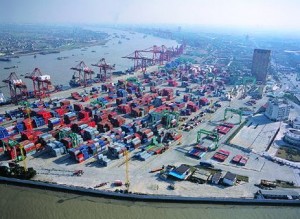
Top 50 World Container Ports

The world’s largest container ports


Top 50 world container portsPorts are hubs that welcome marine vessels so they can dispatch or discharge cargo. In terms of value, seaborne trade carried by container ships is the most important category of waterborne freight, and container handling is one of the key sources of revenue produced by the operation and management of a port. Intermodal containers usually have a capacity of one or two twenty-foot equivalent units, a standard unit of measure which is often being abbreviated to TEU. On a global scale, the busiest ports are located in Asia, the largest ones being Shanghai, Singapore and Hong Kong. The Port of Los Angeles and the adjoining Port of Long Beach together form the largest port in the United States. The cities of Rotterdam, Hamburg and Antwerp are home to the largest ports in Europe.
 

Rank Port
1 Shanghai, China
2 Singapore
3 Shenzhen, China
4 Hong Kong, S.A.R., China
5 Bussan, South Korea
6 Ningbo-Zhou Shan, China
7 Qingdao, China
8 Guangzhou Harbor, China
9 Jebel Ali, Dubai, United Arab Emirates
10 Tianjin, China
11 Rotterdam
12 Dalian, China
13 Port Kelang, Malaysia
14 Kaohsiung, Taiwan
15 Hamburg, Germany
16 Antwerp, Belguim
17 Keihin ports*, Japan
18 Xiamen, China
19 Los Angeles, U.S.A.
20 Tanjung Pelepas, Malaysia
21 Long Beach, U.S.A.
22 Tanjung Priok, Jakarta, Indonesia
23 Laem Chabang, Thailand
24 Ho Chi Minh, Vietnam
25 Bremen/Bremerhaven, Germany
26 Lianyungung, China
27 New York-New Jersey, U.S.A.
28 Hanshin* ports, Japan
29 Yingkou, China
30 Jeddah, Saudi Arabia
31 Algerciras Bay, Spain
32 Valencia, Spain
33 Columbo, Sri Lanka
34 Jawaharlal Nehru, India
35 Sharjah, United Arab Emirates
36 Manila, Philippines
37 Felixstowe, U.K.
38 Santos, Brazil
39 Ambarli, Turkey
40 Colon, Panama
41 Salalah, Oman
42 Balboa, Panama
43 Port Said East, Egypt
44 Gioia Tauro, Italy
45 Georgia Ports, U.S.A.
46 Tanjung Perak, Surabaya, Indonesia
47 Metro Vancouver, Canada
48 Marsaxlokk, Malta
49 Nagoya, Japan
50 Durban, South Africa

How to Calculate Dimensional Weight

What is dimensional weight?

Dimensional weight reflects package density, which is the amount of space a package occupies in relation to its actual weight.

Billable weight is the weight used to calculate your rate. For domestic and international services, the billable weight will either be the dimensional weight or the actual weight of your package (whichever number is greater).

Dimensional Weight

How is dim weight calculated?

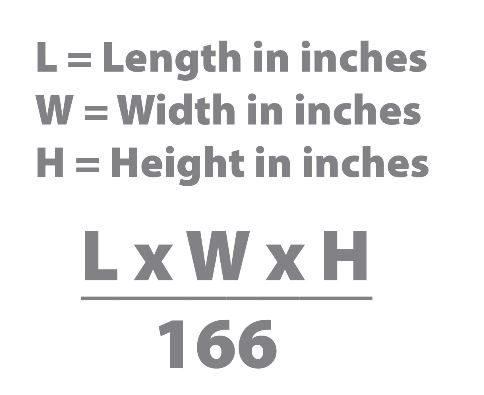
Dimensional weight is calculated based on the length, height, and width of the package. The dimensional weight becomes the billable weight when the dimensional weight of your package exceeds its actual weight.

Follow these easy steps to calculate dimensional weight:

  1. Calculate the cubic size of your package in inches. Multiply the length by width by height of your package. Round each measurement to the nearest whole inch. The resulting total is the cubic size of your package.
  2. Determine actual weight. Use any standard scale to determine the actual weight of your package. Increase any fraction to the next whole pound.
  3. Determine dimensional weight. Divide the cubic size of your package in inches by 166 (for shipments within the U.S. and shipments between the U.S. and Puerto Rico) or 139 ( for international shipments).
  4. Determine billable weight. Compare the package’s actual weight to its dimensional weight. The larger of the two weights is the billable weight and should be used to calculate the rate.
  5. For multiple-package shipments, total the billable weight of all packages in the shipment.


This method is used to calculate Air and Ocean freight charges billed by shipping companies. When a package is delivered to a shipping company, it is weighed and the volume is determined. The charge of the shipment is based on whatever is higher.

Sample Calculation of chargeable weight

Ship Method / Destination: Ground / Domestic
Actual Weight: 21 pounds
Length: 30 inches
Width: 12 inches
Height: 12 inches
Cubic Size Calculation: 30 x 12 x 12 = 4,320 cubic inches
Dimensional Weight Calculation: 4,320/166 = 26 pounds

In this first example, because it is a domestic shipment, we multiply the total cubic size in inches by 166. In doing so, we find out that the dimensional weight is 26 pounds, which is greater than the actual weight.

However, because the package is being shipped via ground service and is less than 5,184 cubic inches, the dimensional weight is not applied. So in this case, the actual weight of 21 lbs. becomes the billable weight.

Ship Method / Destination: Air / International
Actual Weight: 18 pounds
Length: 24 inches
Width: 12 inches
Height: 12 inches
Cubic Size Calculation: 24 x 12 x 12 = 3,456 cubic inches
Dimensional Weight Calculation: 3,456/139 = 25 pounds