ATA Freight Line

ATA Freight Line celebrates 20 years by leading the way for a new breed of logistics provider

Garden City, New York – Sept. 1, 2015 – ATA Freight Line is pleased to announce our upcoming 20 year anniversary by launching several innovative products including the revolutionary shipment management software, Vizio MyWay.

Founded in 1996 and headquartered in New York, ATA Freight Line has evolved from a traditional freight forwarder to becoming a leading global logistics provider of personalized and innovative solutions.

Over the course of 20 years we have steadily expanded, opening locations throughout the USA, Turkey, India, China & Mexico.

A recent survey found almost 70% of ATA clients said communication and responsiveness is what set ATA apart from the other providers.

Integrity, commitment and excellence are at the heart of ATA Freight Line’s values. Our people, our most valuable asset, are the key to ensure our values live today and will thrive tomorrow. Our core strengths – Responsive Service, Innovative Solutions, and Specialized Trade Lane Expertise – are the foundation holding our strong company values together. We give freedom and control to our customers with a personal touch.


To see more information about our products please visit www.atafreight.com

  • Vizio MyWay – a full service shipment management solution
  • ATAGuarantees – our personal service guarantee
  • ATAPremier – a loyalty membership package like no other
  • ATACares – a client care notification system to keep all of our customers aware of what going on in this ever-changing industry

ATA Freight Line, led by Chairman & CEO of ATA Group of Companies, Mr. CJ Oguzhan, earned recognition from John Deere as Partner-level Supplier five years in a row, placing us into the Supplier Hall of Fame for 2014. ATA Impex, part of ATA Group of Companies, also received John Deere’s Supplier Innovation Award for 2014 in recognition of suppliers who think creatively.

“We are thrilled to be reaching our 20th year as a fully integrated global logistics service provider,” Mr. Oguzhan said. “There is a demand out there for a new generation of logistics providers. Our expert lane specialists are fully dedicated to providing only the best in responsive communication and totally customizable products and software. We, at ATA, are the first of our kind and are excited to be leading this movement.”

ATA Freight Line

What is a freight forwarder

International Freight Forwarders

There are a lot of confusion when it comes to the various companies offering logistics services. from International freight forwarders to  3PL, 4PL and 7PL companies in addition to the many other types of companies.

International Freight Forwarders


Below is a simple definition of a freight forwarder

A Firm specializing in arranging storage and shipping of merchandise on behalf of its shippers. It usually provides a full range of services including: tracking inland transportation, preparation of shipping and export documents, warehousing, booking cargo space, negotiating freight charges, freight consolidation, cargo insurance, and filing of insurance claims. Freight forwarders usually ship under their own bills of lading or air waybills (called house bill of lading or house air waybill) and their agents or associates at the destination (overseas freight forwarders) provide document delivery, deconsolidation, and freight collection services. Also called forwarder.

Many traditional freight forwarding companies are offering other services such as: warehousing, distribution, pick and pack services and transportation management.

This has given rise to what we call 3PL companies.

While the idea of moving cargo from A to B sounds simple, like importing, there are complex regulations that govern the movement of freight worldwide. Every country has its own regulations, and different products have different requirements, and keeping track of them all can be daunting for small business owners.

That’s where working with the right freight forwarding company is essential. a freight forwarder should be able to offer you personalized service and  focus on compliance, you can rest easy knowing that your cargo is in good hands and that you won’t be faced with any surprise charges or delays.

International shipping is by now means easy. Shipping a container involves many activities that most people are not aware of. With more and more regulations affecting imports, international freight companies have to stay on top of all the changes in the market place.

Resources:

7pl Logistics


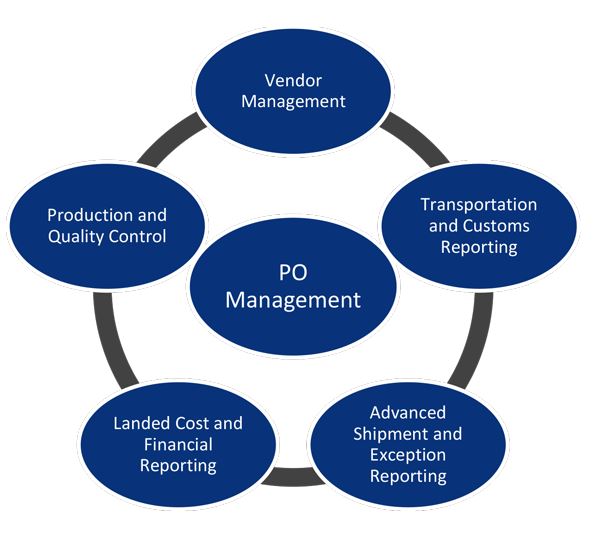
PO Management

What is PO Management ?

Purchase Order ManagementPurchase order management is an internal business function. Companies use a purchasing process to acquire inventories, operational assets and other items needed to produce goods or services. Purchase orders represent an process that gives specific instructions for purchasing different resources.it is well-defined purchase order process. purchase order management policies are created to ensure employees follow standard operating procedures for this process.

What does a PO Management System Offer?


Purchase Order Monitoring

Vendor Compliance

Product Collection and Booking

Consolidation and Customs Loading

Real-Time Data

Upstream System Tracking

Order Management Bookings

Origin Pre-Distribution programs

This program allows importers to ship the product according to current market conditions without paying the re-handling costs of de-consolidation at destination.

Consolidation Services

Optimize container loading and shipment flow through consolidation of LCL shipments. Order to reflect demand reducing carrying costs, inventory levels, order to cash cycle, and transportation costs.

Vendor Liaison

Origin teams coordinate with vendors and/or buying offices to: Maintain purchase order database, coordinate vendor booking and equipment, meet delivery requirements and collect and follow-up with documents.

Purchase Order Management

Order Management captures Purchase Order (PO) details to 3 levels down from the PO (PO, Item, SKU [color/size]) to monitor booking, receiving and shipping. Information captured within Order Management and the subsequent reporting capabilities further enhance abilities to manage purchase orders and overall cargo flow. Customers can print container manifests & vessel summaries, query by buyer, DC, division and others. PO’s are received via EDI, or proprietary format.

Vendor Management

Order Management vendor management and vendor education programs educate vendors on Order Management practices and unique requirements of our customers. Clear communication and understanding operational and documentation requirements support a smooth supply chain. Additional vendor management programs are available.

Documentation

Order Management document services include preparation, collection, verification, dispatch and follow-up. Our staff can assist you with your commercial documentation needs.

Value Added

Origin services include: Ex-factory trucking, origin pre-distribution, production / assembly visibility, bar coding, GOH, ticketing, labeling, scanning, facilitation of inspection space, multiple country consolidation, sample forwarding, DC bypass loads, sea-air conversion and others.

Warehouse Operations


Read more at: http://www.pomanagement.net

How to Calculate Dimensional Weight

What is dimensional weight?

Dimensional weight reflects package density, which is the amount of space a package occupies in relation to its actual weight.

Billable weight is the weight used to calculate your rate. For domestic and international services, the billable weight will either be the dimensional weight or the actual weight of your package (whichever number is greater).

Dimensional Weight

How is dim weight calculated?

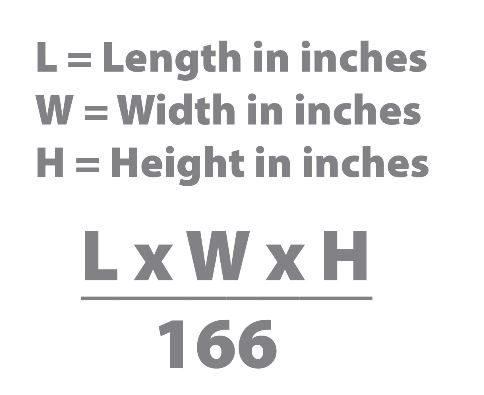
Dimensional weight is calculated based on the length, height, and width of the package. The dimensional weight becomes the billable weight when the dimensional weight of your package exceeds its actual weight.

Follow these easy steps to calculate dimensional weight:

  1. Calculate the cubic size of your package in inches. Multiply the length by width by height of your package. Round each measurement to the nearest whole inch. The resulting total is the cubic size of your package.
  2. Determine actual weight. Use any standard scale to determine the actual weight of your package. Increase any fraction to the next whole pound.
  3. Determine dimensional weight. Divide the cubic size of your package in inches by 166 (for shipments within the U.S. and shipments between the U.S. and Puerto Rico) or 139 ( for international shipments).
  4. Determine billable weight. Compare the package’s actual weight to its dimensional weight. The larger of the two weights is the billable weight and should be used to calculate the rate.
  5. For multiple-package shipments, total the billable weight of all packages in the shipment.


This method is used to calculate Air and Ocean freight charges billed by shipping companies. When a package is delivered to a shipping company, it is weighed and the volume is determined. The charge of the shipment is based on whatever is higher.

Sample Calculation of chargeable weight

Ship Method / Destination: Ground / Domestic
Actual Weight: 21 pounds
Length: 30 inches
Width: 12 inches
Height: 12 inches
Cubic Size Calculation: 30 x 12 x 12 = 4,320 cubic inches
Dimensional Weight Calculation: 4,320/166 = 26 pounds

In this first example, because it is a domestic shipment, we multiply the total cubic size in inches by 166. In doing so, we find out that the dimensional weight is 26 pounds, which is greater than the actual weight.

However, because the package is being shipped via ground service and is less than 5,184 cubic inches, the dimensional weight is not applied. So in this case, the actual weight of 21 lbs. becomes the billable weight.

Ship Method / Destination: Air / International
Actual Weight: 18 pounds
Length: 24 inches
Width: 12 inches
Height: 12 inches
Cubic Size Calculation: 24 x 12 x 12 = 3,456 cubic inches
Dimensional Weight Calculation: 3,456/139 = 25 pounds


Supply Chain Management

The Supply Chain Management Processes

Supply chain management is the management of relationships in the network of organizations, from end customers through original suppliers, using key cross-functional business processes to create value for customers and other stakeholders.

supply chain management is being recognized as the management of key business processes across the network of organizations that comprise the supply chain. While many have recognized the benefits of a process approach to managing the business and the supply chain, most are not clear about what processes are to be considered, what sub‐processes and activities are contained in each process, and how the processes interact with each other and with the traditional functional icons.

The supply chain Processes

Customer Relationship Management
Customer Service Management
Demand management
Order Fulfillment
Manufacturing Flow Management
Supplier Relationship Management
Product Development and Commercialization

Supply Chain Planning is an amalgamation of all the planning processes across various business planning functions such as Materials Requirement Planning, Sourcing and Distribution Network Planning, Inventory Planning, Financial Planning, and so on.

Manufacturers need to collaborate with suppliers, distributors and retailers to manage a balance between supply and demand. To achieve this, Collaborative Planning, Forecasting, and Replenishment (CPFR) model has been adopted by many manufacturers.

Learn More at http://www.pomanagement.com


Supply Chain Management

Supply chain management (SCM) is the oversight of materials, information, and finances as they move in a process from supplier to manufacturer to wholesaler to retailer to consumer. Supply chain management involves coordinating and integrating these flows both within and among companies. It is said that the ultimate goal of any effective supply chain management system is to reduce inventory (with the assumption that products are available when needed). As a solution for successful supply chain management, sophisticated software systems with Web interfaces are competing with Web-based application service providers who promise to provide part or all of the SCM service for companies who rent their service.

Supply chain management flows can be divided into three main flows:

The product flow
The information flow
The finances flow

The product flow includes the movement of goods from a supplier to a customer, as well as any customer returns or service needs. The information flow involves transmitting orders and updating the status of delivery. The financial flow consists of credit terms, payment schedules, and consignment and title ownership arrangements.

There are two main types of SCM software: planning applications and execution applications. Planning applications use advanced algorithms to determine the best way to fill an order. Execution applications track the physical status of goods, the management of materials, and financial information involving all parties.
Some SCM applications are based on open data models that support the sharing of data both inside and outside the enterprise (this is called the extended enterprise, and includes key suppliers, manufacturers, and end customers of a specific company). This shared data may reside in diverse database systems at several different sites and companies.

By sharing this data “upstream” (with a company’s suppliers) and “downstream” (with a company’s clients), SCM applications have the potential to improve the time-to-market of products, reduce costs, and allow all parties in the supply chain to better manage current resources and plan for future needs.
Increasing numbers of companies are turning to Web sites and Web-based applications as part of the SCM solution.

Supply chain management (SCM) is the combination of art and science that goes into improving the way your company finds the raw components it needs to make a product or service and deliver it to customers. The following are five basic components of SCM.

International 3PL understands your needs for supply chain management and will work with you to achieve your goals

3PL vs 4PL

What is the difference between 3PL and 4PL?

The CSCMP defines 3PL as follows:

Outsourcing all or much of a company’s logistics operations to a specialized company. The term “3PL” was first used in the early 1970s to identify intermodal marketing companies (IMCs) in transportation contracts. Up to that point, contracts for transportation had featured only two parties, the shipper and the carrier. When IMCs entered the picture—as intermediaries that accepted shipments from the shippers and tendered them to the rail carriers—they became the third party to the contract, the 3PL. Definition has broadened to the point where these days, every company that offers some kind of logistics service for hire calls itself a 3PL. Preferably, these services are integrated, or “bundled,” together by the provider. Services they provide are transportation, warehousing, cross-docking, inventory management, packaging, and freight forwarding. In 2008 legislation passed declaring that the legal definition of a 3PL is “A person who solely receives, holds, or otherwise transports a consumer product in the ordinary course of business but who does not take title to the product.”

The CSCMP defines 4PL as follows:
(more…)

Collection Services

Collections Masters

Collection MastersInternational 3PL has partnered with collections Masters to offer receivables management services.

Even if you have a profitable business yet you have a lot of outstanding debt, most likely in a year or two, you will not have enough cash to fund you operation. That is why you need a professional company to handle your credit and collections.
Collections masters offers many services other than debt recovery, we offer factoring and purchase order financing.

A professional collection service such as collections masters can assist you in collecting accounts that remain delinquent. we  have a vast knowledge of collection techniques, technology and compliance issues. Using a our service will save time and likely yield better results than you can achieve on your own.

When accounts reach 90 to 120 days past due, it’s time to consider placing them with a collection agency. If you wait over a year it is unlikely you will get paid, but possible. If you are letting something sit on your books and grow older without actively pursuing it, it is worth it to give it to a collection agency. It’s not going to get collected if you keep it, and the percentage you will pay the agency will be well worth it.

We focus on the total solution for your company cash flow. Such services include:

  • Debt Recovery.
  • Factoring.
  • Purchase order Financing.
  • Forensic accounting.
  • Credit worthiness assessment.
  • Credit Insurance.

We work with lading companies in the US and around the world to make sure that you have the cash that you need to operate your business.

Doing Business with Bolivia

Bolivia Export

Bolivia ExportIn the last two decades Bolivia has become a major exporter of natural gas (43 percent of total exports). Other exports include: silver (12 percent of total exports), zinc (10 percent) and soybeans and related products (7 percent). Main export partners are: Brazil (33 percent of total exports), Argentina (12 percent) and United States (10 percent). Others include: Peru, South Korea, China and Belgium

Bolivia export.com is dedicated to serving the air and ocean shipping needs between North America and South America, specifically Bolivia. we also offer import and export services from and to any part of the World.

Bolivia Export is one of the world’s leading providers of forwarding and logistics services, specializing in end-to-end supply chain management solutions and intercontinental air freight, trucking ocean freight shipments.
We also specialize in customs compliance and advise on many regulations.
Our rates are competitive, our service is exceptional.

http://www.boliviaexport.com

WhatsApp chat