Best Third Party Logistics Companies

What Sets us apart from the competition? What makes us one of the Best Third Party Logistics Companies ?

We can support supply chain requirements throughout the product life cycle. From Manufacturing and product packaging through end-of-life services such as liquidation and recycling, We supply chain solutions that deliver the greatest return on investment for your products.

Third Party Logistics Companies

  • Ocean Freight Services
  • Import Freight Services
  • Export Freight Services
  • Packaging
    Product packaging and assembly combined with distribution operations.
  • Warehousing and Distribution
  • Transportation Logistics
  • Reverse Logistics
    Management of the reverse flow of product, information and cash, including value-added services such as test, repair and refurbishment; product recall management; and recycling services
  • Inventory Liquidation
  • Damage Research
  • Sustainability
    Sustainable practices, including recycling services and continuous improvement methodology, designed to provide visibility, be regulatory compliant, meet data security requirements and ensure the highest recovery value

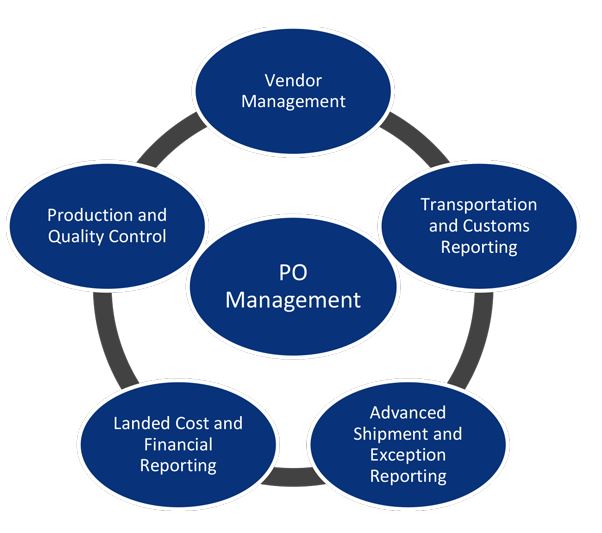
PO Management

What is PO Management ?

Purchase Order ManagementPurchase order management is an internal business function. Companies use a purchasing process to acquire inventories, operational assets and other items needed to produce goods or services. Purchase orders represent an process that gives specific instructions for purchasing different resources.it is well-defined purchase order process. purchase order management policies are created to ensure employees follow standard operating procedures for this process.

What does a PO Management System Offer?


Purchase Order Monitoring

Vendor Compliance

Product Collection and Booking

Consolidation and Customs Loading

Real-Time Data

Upstream System Tracking

Order Management Bookings

Origin Pre-Distribution programs

This program allows importers to ship the product according to current market conditions without paying the re-handling costs of de-consolidation at destination.

Consolidation Services

Optimize container loading and shipment flow through consolidation of LCL shipments. Order to reflect demand reducing carrying costs, inventory levels, order to cash cycle, and transportation costs.

Vendor Liaison

Origin teams coordinate with vendors and/or buying offices to: Maintain purchase order database, coordinate vendor booking and equipment, meet delivery requirements and collect and follow-up with documents.

Purchase Order Management

Order Management captures Purchase Order (PO) details to 3 levels down from the PO (PO, Item, SKU [color/size]) to monitor booking, receiving and shipping. Information captured within Order Management and the subsequent reporting capabilities further enhance abilities to manage purchase orders and overall cargo flow. Customers can print container manifests & vessel summaries, query by buyer, DC, division and others. PO’s are received via EDI, or proprietary format.

Vendor Management

Order Management vendor management and vendor education programs educate vendors on Order Management practices and unique requirements of our customers. Clear communication and understanding operational and documentation requirements support a smooth supply chain. Additional vendor management programs are available.

Documentation

Order Management document services include preparation, collection, verification, dispatch and follow-up. Our staff can assist you with your commercial documentation needs.

Value Added

Origin services include: Ex-factory trucking, origin pre-distribution, production / assembly visibility, bar coding, GOH, ticketing, labeling, scanning, facilitation of inspection space, multiple country consolidation, sample forwarding, DC bypass loads, sea-air conversion and others.

Warehouse Operations


Read more at: http://www.pomanagement.net

Supply Chain Management

The Supply Chain Management Processes

Supply chain management is the management of relationships in the network of organizations, from end customers through original suppliers, using key cross-functional business processes to create value for customers and other stakeholders.

supply chain management is being recognized as the management of key business processes across the network of organizations that comprise the supply chain. While many have recognized the benefits of a process approach to managing the business and the supply chain, most are not clear about what processes are to be considered, what sub‐processes and activities are contained in each process, and how the processes interact with each other and with the traditional functional icons.

The supply chain Processes

Customer Relationship Management
Customer Service Management
Demand management
Order Fulfillment
Manufacturing Flow Management
Supplier Relationship Management
Product Development and Commercialization

Supply Chain Planning is an amalgamation of all the planning processes across various business planning functions such as Materials Requirement Planning, Sourcing and Distribution Network Planning, Inventory Planning, Financial Planning, and so on.

Manufacturers need to collaborate with suppliers, distributors and retailers to manage a balance between supply and demand. To achieve this, Collaborative Planning, Forecasting, and Replenishment (CPFR) model has been adopted by many manufacturers.

Learn More at http://www.pomanagement.com


Supply Chain Management

Supply chain management (SCM) is the oversight of materials, information, and finances as they move in a process from supplier to manufacturer to wholesaler to retailer to consumer. Supply chain management involves coordinating and integrating these flows both within and among companies. It is said that the ultimate goal of any effective supply chain management system is to reduce inventory (with the assumption that products are available when needed). As a solution for successful supply chain management, sophisticated software systems with Web interfaces are competing with Web-based application service providers who promise to provide part or all of the SCM service for companies who rent their service.

Supply chain management flows can be divided into three main flows:

The product flow
The information flow
The finances flow

The product flow includes the movement of goods from a supplier to a customer, as well as any customer returns or service needs. The information flow involves transmitting orders and updating the status of delivery. The financial flow consists of credit terms, payment schedules, and consignment and title ownership arrangements.

There are two main types of SCM software: planning applications and execution applications. Planning applications use advanced algorithms to determine the best way to fill an order. Execution applications track the physical status of goods, the management of materials, and financial information involving all parties.
Some SCM applications are based on open data models that support the sharing of data both inside and outside the enterprise (this is called the extended enterprise, and includes key suppliers, manufacturers, and end customers of a specific company). This shared data may reside in diverse database systems at several different sites and companies.

By sharing this data “upstream” (with a company’s suppliers) and “downstream” (with a company’s clients), SCM applications have the potential to improve the time-to-market of products, reduce costs, and allow all parties in the supply chain to better manage current resources and plan for future needs.
Increasing numbers of companies are turning to Web sites and Web-based applications as part of the SCM solution.

Supply chain management (SCM) is the combination of art and science that goes into improving the way your company finds the raw components it needs to make a product or service and deliver it to customers. The following are five basic components of SCM.

International 3PL understands your needs for supply chain management and will work with you to achieve your goals