
PO Management
What is PO Management ?
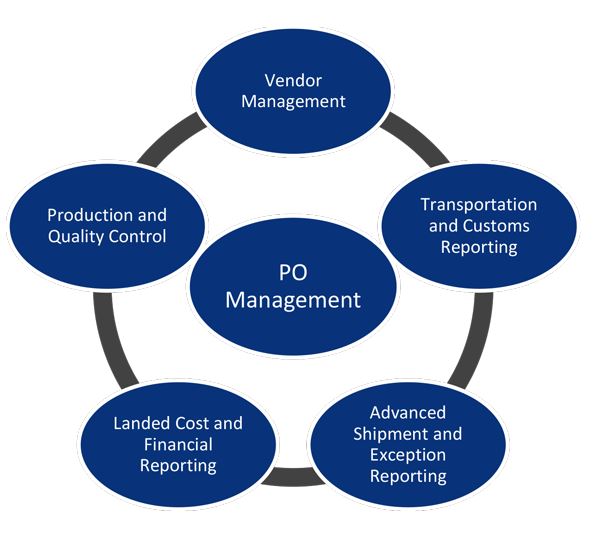 Purchase order management is an internal business function. Companies use a purchasing process to acquire inventories, operational assets and other items needed to produce goods or services. Purchase orders represent an process that gives specific instructions for purchasing different resources.it is well-defined purchase order process. purchase order management policies are created to ensure employees follow standard operating procedures for this process.
What does a PO Management System Offer?
Purchase Order Monitoring
Vendor Compliance
Product Collection and Booking
Consolidation and Customs Loading
Real-Time Data
Upstream System Tracking
Order Management Bookings
Origin Pre-Distribution programs
This program allows importers to ship the product according to current market conditions without paying the re-handling costs of de-consolidation at destination.
Consolidation Services
Optimize container loading and shipment flow through consolidation of LCL shipments. Order to reflect demand reducing carrying costs, inventory levels, order to cash cycle, and transportation costs.
Vendor Liaison
Origin teams coordinate with vendors and/or buying offices to: Maintain purchase order database, coordinate vendor booking and equipment, meet delivery requirements and collect and follow-up with documents.
Purchase Order Management
Order Management captures Purchase Order (PO) details to 3 levels down from the PO (PO, Item, SKU [color/size]) to monitor booking, receiving and shipping. Information captured within Order Management and the subsequent reporting capabilities further enhance abilities to manage purchase orders and overall cargo flow. Customers can print container manifests & vessel summaries, query by buyer, DC, division and others. PO’s are received via EDI, or proprietary format.
Vendor Management
Order Management vendor management and vendor education programs educate vendors on Order Management practices and unique requirements of our customers. Clear communication and understanding operational and documentation requirements support a smooth supply chain. Additional vendor management programs are available.
Documentation
Order Management document services include preparation, collection, verification, dispatch and follow-up. Our staff can assist you with your commercial documentation needs.
Value Added
Origin services include: Ex-factory trucking, origin pre-distribution, production / assembly visibility, bar coding, GOH, ticketing, labeling, scanning, facilitation of inspection space, multiple country consolidation, sample forwarding, DC bypass loads, sea-air conversion and others.
Warehouse Operations
You must be logged in to post a comment.