TPL

TPL is an acronym for third party logistics“Thirdparty logistics (abbreviated 3PL, or sometimes TPL) in logistics and supply chain management is a company’s use of thirdparty businesses to outsource elements of the company’s distribution and fulfillment services.”

When looking to outsource all or part of a company’s logistics function it is important to look for a third party logistics provider with proven expertise. To put it simply, third party logistics or “3PL” is the integration of a company’s shipping, warehousing, distribution, transportation, and related logistics services through an outsourced or “third party” partnership. We provide our clients with powerful logistics solutions involving people, technology and location working together to provide integrated, full service supply chain management.

With comprehensive 3PL services; supply chain efficiency, customer satisfaction and brand value growth come together to benefit you. We bridge the gap between your goods and your customers.

We Specialize in designing efficient and cost effective logistics solutions customized to client’s specific needs. This allows you to focus on core competencies and receive a logistical advantage over the competition through the use of TPL’s professional third party logistics services.

Advantages of TPL Companies include:

  • Allows flexibility to expand and contract inventory levels
  • Enhanced technology and supply chain visibility
  • Improved customer service offerings
  • Allows companies to focus on core competencies
  • A more strategic and scientific approach to logistics challenges
  • Lower or eliminate capital expenditures associated with equipment and facilities.

TPL Companies offer a variety of value-added services to enhance customer’s warehousing and transportation programs including: kitting and final assembly, labeling, shrink wrapping, and pick/pack services.
Site Selection
We leverage expansive networks and industry knowledge to aid Customers in selecting a strategically placed warehouse site that is optimal for your specific distribution program.

Rate Assessment
By conducting a formal examination on client shipment history and rates in historical lanes of service our transportation analysts can cut cost out of your transportation program.

Inventory Management
Our best in class approach to inventory management insures a quantifiable inventory accuracy of 99.9%.

Vendor Management
For customers that wish to keep their own carriers in conjunction with, or in place of, We offer assistance in managing load planning activities and carrier performance.

Freight Management
We work with hand-selected carriers who have formed strong partnerships with International 3PL offering the best service when it comes to Ocean, air or inland transportation.

Some of the services offered by TPL Companies:

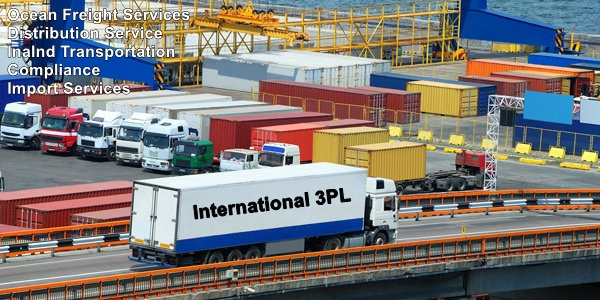
Ocean Freight Services

Air Freight Services

Shipping consolidation

Warehousing

Inland Transportation
 

Contract Logistics

What is a Contract Logistics

Contract logistics companies handle activities that include but not limited to the design and planning of supply chains, designing facilities, warehousing, transporting and distributing goods, order processing ,  managing inventory and even providing certain aspects of customer service. and collections

Supply Chain Activities involve transportation, customs clearance, and warehousing activities in one or more locations in the entire network. Contract Logistics make up an integral part of the supply Chain. Global operations are the way to go 

While some companies manage their own logistics, others find it more efficient to outsource to specialized contract logistics companies to manage their logistics for them. 
Normally in Logistics, the frond end of the businesses would be the Freight Forwarders, Transport Companies and Warehousing Service Providers. In many cases Freight Forwards own and manage warehousing facilities too.

While Freight Forwarding is an important function of 3PL Service providers to facilitate the Supply Chain, another equally important function managed by 3PL Logistics Companies is Contract Logistics.

Under the broad umbrella of Contract Logistics, 3PL providers provide services of setting up consolidation centers, distribution centers, warehouses and inventory management services.

Our customized fulfillment logistics allow our customers the complete outsourcing of their product management. It is our goal as a logistics service provider to combine all related logistics functions along the supply chain of our customers in an efficient and reduce the cost along the way.

At International 3PL, we customize solutions to your individual needs and adapt constantly to keep pace with your changing markets.


International Logistics Solutions

If you are involved in international trade, you probably are looking for an international logistics solutions provider. Shipping a product overseas as part of a commercial transaction, the exporter must be aware of packing, labeling, documentation, and insurance requirements.

Many importers rely on an international freight forwarder to perform these services. Some companies require more than just transportation, that is why they employ the services of an International logistics Service provider to help streamline the process.

International Logistics Solutions is:

That part of the supply chain involved with the planning, implementing and controlling of the efficient, effective flow and storage of goods, services, and related information from point of origin to point of consumption for the purpose of conforming to customer requirements.

Your International Trading Partners are Closer Than You Think with 7PL Logistics.

7Pl Logistics is an international logistics provider with customers ranging from Fortune 500 companies to small businesses. We pride ourselves on delivering completely end to end logistics solutions no matter the industry.

Our approach to Logistics Solutions

  • Logistics Cost Control through dynamic shipment routing, premium freight management, and market competitive rates.
  • Accountability managing effective network design, including carrier and supplier compliance with root cause and corrective actions.
  • Visibility via web based solution to your global shipments, including dashboard reporting.
  • Flexibility with our forwarder neutral model. We match the best service provider for your needs to match capacity with capability.
  • Cost Savings with the implementation of lean tools to your fulfillment stream to reduce waste.
  • Accountability managing effective network design, including carrier and supplier compliance with root cause and corrective actions.
  • Visibility via web based solution to your global shipments, including dashboard reporting.
  • Flexibility with our forwarder neutral model. We match the best service provider for your needs to match capacity with capability.
  • Cost Savings with the implementation of lean tools to your fulfillment stream to reduce waste.

The number of businesses opening their doors to the global market is steadily increasing and customers now expect to have access to products no matter where they come from. Expectations have grown high and they are more likely to buy from merchants who offer shipping options that balance speed and cost.


What is a Third Party Logistics Provider

What is the true Definition of A Third Party Logistics Provider?

According to Wikipedia:  A third party logistics provider (abbreviated 3PL, or sometimes TPL) is a firm that provides service to its customers of outsourced (or “Third Party”) logistics services for part, or all of their supply chain management functions. Third party logistics providers typically specialize in integrated operation, warehousing and transportation services that can be scaled and customized to customers’ needs based on market conditions, such as the demands and delivery service requirements for their products and materials.
Often, these services go beyond logistics and include value-added services related to the production or procurement of goods, i.e., services that integrate parts of the supply chain. When this integration occurs, the provider is then called a third-party supply chain management provider (3PSCM) or supply chain management service provider (SCMSP).
3PL targets a particular function in supply management, such as warehousing, transportation, or raw material provision.

A standard definition of just what a third party logistics provider is can vary from contract to contract. Is everyone who thinks they are engaged in a “third-party contract” really involved in a “third-party contract?”
If a distributor, for example, has a truck pull up to their door a few times a day or week to deliver goods to their customers, is this truck their 3PL provider? The answer is NO.

The definition of a third party logistics provider is as confusing as the term supply chain. Even logistics professional struggle with the term. Many companies refer to trucking, ocean freight services or warehousing as 3PL Services.
Warehousing, transportation and storage by itself is not considered 3PL Services and the company that warehouses and transports the goods is not necessarily a 3pl provider. It is just a warehouse or a transport company.

Many companies require a transport company to deliver the gods from point A to Point B since it does not make sense in some cases to own your own trucks. These transport companies might not be 3PL providers. If that transport company is involved in the warehousing and distribution of the product then it can be called  third party logistics provider.

Many freight forwarding companies and shipping companies have added services to become 3PL Companies. For example, large freight forwarders will ship your container, handle the necessary customs paper work, deliver the container to their warehouse and distribute the product to end users.

Keep in mind that 3PL companies outsource some of the services to other 3PL companies, for example a customs broker who wants a piece of the action outsources warehousing and distribution to other companies while they appear as the provider of these services.

Is it a wise decision to outsource all these functions to one 3PL Company?

The answer is : it all depends on the end result. in some cases, the 3PL provider is unable to give provide the best transportation rates including ocean or inland therefore, a company my opt to use another 3PL provider. This has given rise to 4PL Companies that will manage the other 3PL companies making sure that the customer gets the best service and the best rates possible.

What is a 7PL Company ?

7PL is still considered a concept. Some 4PL companies offer back office support such as accounting, customer service, billing and receivables management. This concept is called by some 7PL Services. This concept is becoming a reality very quickly.

In a nut shell, the number of companies calling themselves 3PL providers has risen but the reality is that most of them do not offer the true services a 3PL is supposed to provide. As mentioned earlier providing these services without integration.

Whether it is a third party logistics provider, a fourth party logistics provider or a 7PL Provider, the bottom line is which one will be able to offer end to end solutions.


Selecting A Third Party Logistics (3PL) Provider

Third party logistics providers (3PL) are a becoming an important part of today’s supply chain. These companies offer services that can allow businesses to outsource part or all of their supply chain management activities. Many 3PL companies offer a wide range of services including; inbound freight, freight consolidation, warehousing, distribution, order fulfillment and outbound freight.
many freight forwarding companies have evolved into third party logistics companies in order to be able to attract more businesses by introducing value added services which they outsource themselves to other providers.

The growth of 3PL companies has been driven by the need for businesses to become leaner, more efficient reducing assets and allowing focus on core business processes.

Third Party Logistics Providers

Selecting A Third Party Logistics Provider

Deciding to a use a third party logistics company is a decision that depends on a many of factors that differ from business to business and from location to location. The decision to outsource certain business functions will depend on the company’s plans; future objectives, product lines, expansion, acquisitions, etc.

Once a decision has been made to outsource certain processes then a company will begin a search for the right 3PL that fits all their requirements at the best possible price. There are three types of Third Party Logistics Providers or companies that operate today.

  • Asset Based
  • Management Based
  • Integrated Providers

Asset based third party logistics companies use their own trucks, warehouses and personnel to operate their business. Management based companies provide the technological and managerial functions to operate the logistics functions of their clients, but do so using the assets of other companies and do not necessarily own any assets. The third category, Integrated Providers, can either be asset based or management based companies that supplement their services with whatever services are needed by their clients.

When selecting a 3PL, the request for information (RFI) or quotation (RFQ) should be as detailed as possible. The company that is selected should be able to fulfill all the logistics requirements and that can only be assured if every requirement is communicated to potential companies. The RFI should include a detailed description of the areas to be outsourced. This will usually include:

  • The scope of the contract, including locations, facilities, departments.
  • Information on volumes involved; number of deliveries, warehouse sizes, number of items, etc.
  • The logistics tasks are to be performed, e.g. warehousing, transportation, etc.
  • The level of performance required.

After the bids have been received by a company from the prospective third party logistics providers, an evaluation would take place where a multi-discipline team will review each bid based on a pre-defined set of criteria. These will include some of the following.

  • Does the 3PL provide the services required?
  • Does the 3PL have the technology required to perform the tasks required?
  • Does the company have the required warehouse space, dock capacity, warehouse personnel, etc.?
  • Is the 3PL financially sound?
  • Are the 3PL’s geographical locations suitable to cover the network?
  • Does the 3PL have the flexibility to respond to changes?
  • Are the 3PL’s environmental policies compatible?
  • Are the costs of the services detailed enough for comparison to other bids?
  • Are the customer references acceptable?
  • Is the 3PL a good cultural fit?


3PL Companies

3PL is a term used for many different types of logistic providers. Each type has its own strengths and weaknesses so be sure to choose the one that fits best with your goals.

3PL Companies, in order to succeed, have to work with their clients as partners. One vision, one goal.

3pl Companies

Here are some of the reason why you should consider a third party.

Lower Rates

When you choose to work with a 3PL you can take advantage of lower rates. Typically, logistics providers have special rates they can provide you with to help save you money in the long run.

Lower Risk

When you work with a 3PL you can start to build an efficient, multi-location distribution network with a lower risk. Without a third party logistics partner, you would have to invest significant capital to build up a distribution network.

Extra Resources

When you work with a third party logistics provider you gain all of their resources as your own. Each provider has their own resources, so make sure to pick one that fits with your needs. Below are a few resources a 3PL can provide.

  • Equipment
  • Personnel
  • Technology/Software

International 3pl continues to be a leader in Innovation.


Third Party Logistics and Freight Forwarding

Understanding the Difference between 3PL Providers and Freight Forwarders

3Pl ProvidersIn the world of global transport, understanding the differences between supply chain management, freight forwarders and 3PL Providers (3PL) is key. In order to make the best decisions for a company’s transportation and supply chain needs, knowing the difference is vital to the safe and successful transportation of goods from the manufacturer to their end destination.

Freight forwarders move freight from one destination to another, be via road, rail, air or ocean.  Third party logistics companies may perform freight forwarding services simply by providing their common services: moving, storing and processing inventory. Both services relieve a company of managing the minutia of transportation, its paperwork, changing of freight providers, adhering to regulations and for some, paying of duties.

Freight forwarders specialize in the moving of freight.  They are experts in this part of the overall supply chain.  Freight forwarders are not always the transportation companies themselves (although they can be), but more often than not contract with various carriers to ensure maximum options for their clients.  Freight forwarders may choose to work both domestically and globally, therefore working with all modes of transport.  Or they may choose to specialize even further and only work within the domestic space or international space.

Third party logistic providers help move the cargo as mentioned above, but then add extra services, such as storing cargo between transport steps and processing shipments.  Many clients ship their cargo from arrival to various warehouse or distribution centers.  3PL Companies will take items from the transport vehicle and package it with an invoice per each client drop off.  Like a freight forwarder, 3PL providers also work with various authorities and carriers to process paperwork, waybills and invoices as well as paying any fees on behalf of the client.

Both providers will perform the necessary service of ensuring cargo arrives in good condition and meets all regulations and any duties or fees are paid.  But 3PL Providers will perform additional services based on client need.  There is a need for both in the supply chain and deciding which is best is based on company needs, budget, current orders and forecasts.  As with any other service provider, the company must first perform an internal analysis to see what is truly needed and where possible cost savings by outsourcing will come.

Many clients may find that working with a freight forwarder partner who also provides 3PL services is a beneficial way to manage transportation needs when working with an outside vendor.  Knowing that basic freight needs will be accomplished, but there is also the option to add services creates a value added benefit.

Supply Chain Management

The Supply Chain Management Processes

Supply chain management is the management of relationships in the network of organizations, from end customers through original suppliers, using key cross-functional business processes to create value for customers and other stakeholders.

supply chain management is being recognized as the management of key business processes across the network of organizations that comprise the supply chain. While many have recognized the benefits of a process approach to managing the business and the supply chain, most are not clear about what processes are to be considered, what sub‐processes and activities are contained in each process, and how the processes interact with each other and with the traditional functional icons.

The supply chain Processes

Customer Relationship Management
Customer Service Management
Demand management
Order Fulfillment
Manufacturing Flow Management
Supplier Relationship Management
Product Development and Commercialization

Supply Chain Planning is an amalgamation of all the planning processes across various business planning functions such as Materials Requirement Planning, Sourcing and Distribution Network Planning, Inventory Planning, Financial Planning, and so on.

Manufacturers need to collaborate with suppliers, distributors and retailers to manage a balance between supply and demand. To achieve this, Collaborative Planning, Forecasting, and Replenishment (CPFR) model has been adopted by many manufacturers.

Learn More at http://www.pomanagement.com


3PL vs 4PL

What is the difference between 3PL and 4PL?

The CSCMP defines 3PL as follows:

Outsourcing all or much of a company’s logistics operations to a specialized company. The term “3PL” was first used in the early 1970s to identify intermodal marketing companies (IMCs) in transportation contracts. Up to that point, contracts for transportation had featured only two parties, the shipper and the carrier. When IMCs entered the picture—as intermediaries that accepted shipments from the shippers and tendered them to the rail carriers—they became the third party to the contract, the 3PL. Definition has broadened to the point where these days, every company that offers some kind of logistics service for hire calls itself a 3PL. Preferably, these services are integrated, or “bundled,” together by the provider. Services they provide are transportation, warehousing, cross-docking, inventory management, packaging, and freight forwarding. In 2008 legislation passed declaring that the legal definition of a 3PL is “A person who solely receives, holds, or otherwise transports a consumer product in the ordinary course of business but who does not take title to the product.”

The CSCMP defines 4PL as follows:
(more…)